Op-Ed·
Jet Engines Should Stop Chasing Perfect Turbine-Tip Efficiency
By Zong-XiangAugust 14, 2026
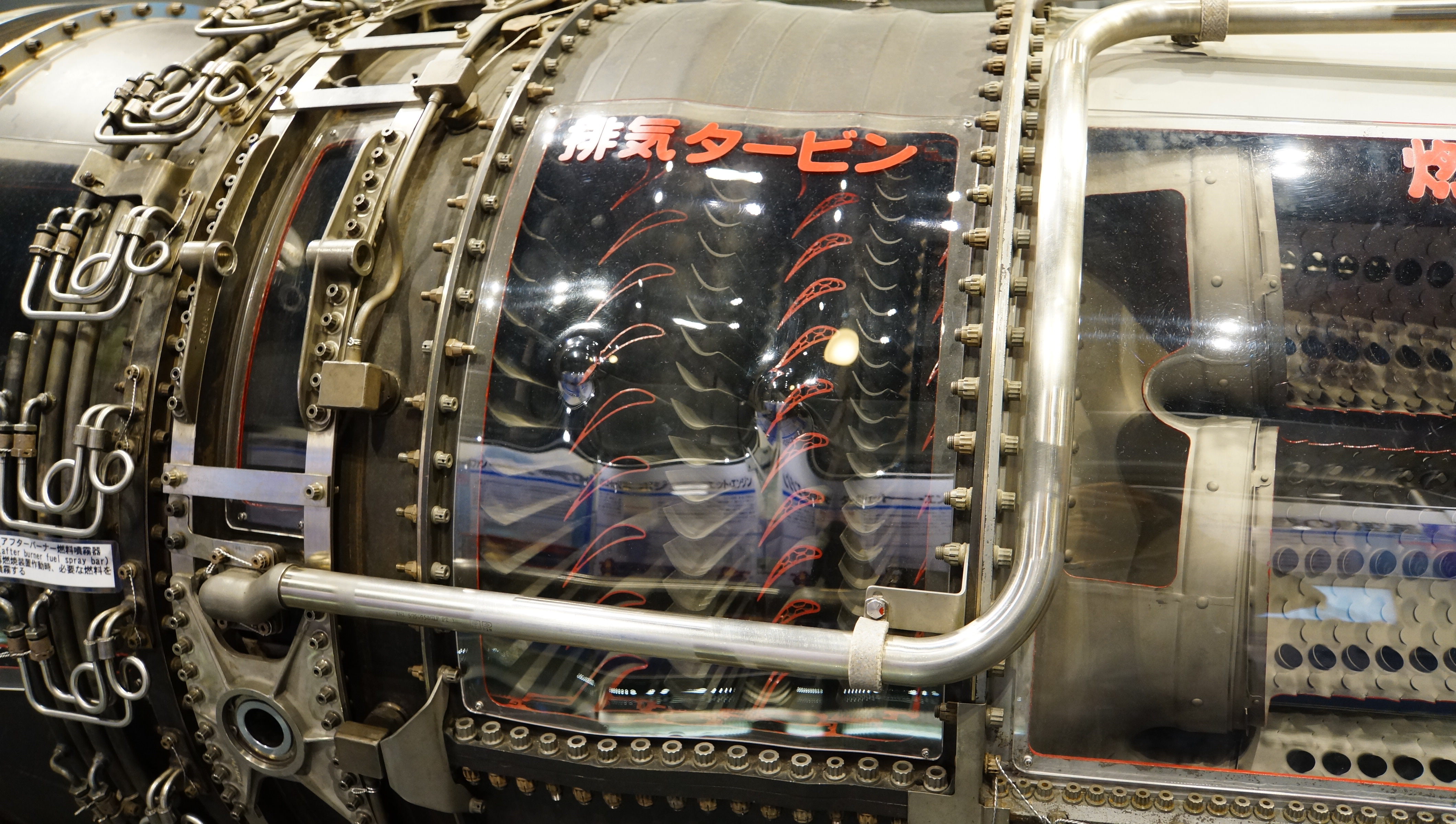
Cutaway view of the turbine section of a J79-IHI-11A turbojet engine. Photo: Hunini / Wikimedia Commons, CC BY-SA 4.0.
Jet-engine engineering is often described as a search for efficiency. Reduce a little drag here, improve combustion there, and the engine burns less fuel. But deep inside the high-pressure turbine, I think this logic can become too simplistic. One of the best examples is the squealer tip, a tiny recessed cavity at the end of a turbine blade. Engineers use it to reduce the hot gas leaking through the clearance between the blade and the engine casing. The controversial part is that the design that leaks the least gas is not necessarily the design I would want inside an aircraft engine.
Tip leakage is genuinely expensive. Pressure differences across a turbine blade force hot gas through the small gap above its tip, creating vortices and aerodynamic losses. Squealer rims increase resistance to this flow, almost behaving like a miniature labyrinth seal. Recent research still treats suppressing this leakage as an important path toward better turbine performance.
However, efficiency is only half of the problem. The blade tip is also exposed to some of the most severe heat transfer in the turbine. Experiments have shown that hot leakage flow can reattach or impinge inside a squealer cavity, producing intense local heating. In one transonic study, a cavity tip performed better aerodynamically than a flat tip at one operating condition because it reduced discharge through the clearance. Yet the same cavity produced higher peak and average heat transfer.
That tradeoff should matter more than a tiny theoretical efficiency victory. A turbine blade is not a CFD plot. It is a rotating metal component operating in extremely hot gas while experiencing enormous centrifugal loading. Cooling air can protect it, but that air normally comes from the compressor. Using more coolant therefore carries its own performance penalty. Researchers are still experimenting with squealer geometry, film-cooling holes, inclined rims, trenches, and even impingement systems because improving one part of the problem can worsen another.
My view is that turbine-tip design should be biased toward aerothermal robustness rather than minimum leakage under ideal conditions. If two designs are close in aerodynamic efficiency, I would rather choose the one with lower peak metal temperature, better cooling coverage, and greater tolerance to clearance changes and operating conditions. Aircraft engines do not spend their lives at one laboratory pressure ratio.
This does not mean efficiency should be ignored. Small improvements matter enormously across thousands of flights. But the most elegant turbine tip is not necessarily the one that extracts every possible fraction of a percentage point from the airflow. It is the one that remains efficient while surviving heat, wear, manufacturing variation, and thousands of cycles.
The squealer tip demonstrates a broader engineering principle: optimization stops being useful when the metric becomes more important than the machine.
Discussion
0 commentsNo comments yet. Start the conversation.